07 Set Theory I

这篇笔记介绍lecture12,集合论的内容。

计算问题

如果某个计算问题(Computational Problem)只会严格遵循有限的指令,且在一定次数的操作后一定会终止,则它是可计算的。

集合

基本概念与性质

集合(set)是不同对象的无序收集,这里的对象可以是任何东西,包括其它集合。如果 aa 是集合 AA 中的元素,则 aa 属于 AA ,即 aAa \isin A ;否则,则 aa 不属于 AA ,即 aAa \notin A

在元素较少时,可以直接用大括号表示集合,如 {1,2,3,4}\{1,2,3,4\} 。许多常见集合用大写字母表示,如 CC 为复数集, UU 为考虑范围内所有元素的集合。集合还可以用内涵表示法表示,写为 {xP(x)}\{x|P(x)\}{x:P(x)}\{x:P(x)\} 。这里的 P(x)P(x) 是一个谓词逻辑公式,这个集合表示使 P(x)P(x) 为真的所有 xx 的集合,如 {xx is a prime number}={2,3,5,7,...}\{x|x~is~a~prime~number\} = \{2,3,5,7,...\}

如果集合 AABB 中的元素是完全相同的,则 AABB 相等,即 A=B(x)(xAxB)A = B \Leftrightarrow (\forall x)(x \isin A \leftrightarrow x \isin B) 。如果集合 AA 中的每个元素都出现在集合 BB 中,则 AA 包含于 BB ,也称 AABB 的子集(subset),即 AB(x)(xAxB)A \subseteq B \Leftrightarrow (\forall x)(x \isin A \rightarrow x \isin B) 。如果 AABB 的子集且 ABA \not = B ,则 AABB 的真子集(proper subset),即 AB(ABAB)A \subset B \Leftrightarrow (A \subseteq B \land A \not = B) 。空集是任何集合的子集。

集合有三条性质:无序性(unorder)、相异性(distinction)、确定性(deterministic)。无序性指,集合中元素的排列顺序不重要。相异性指,集合中不能出现两个(或多个)同样的元素。确定性指,对于元素 aa ,只存在 aAa \isin AaAa \notin A 两种情况,并且 aa 是否属于 AA 是确定的且互斥的。

运算

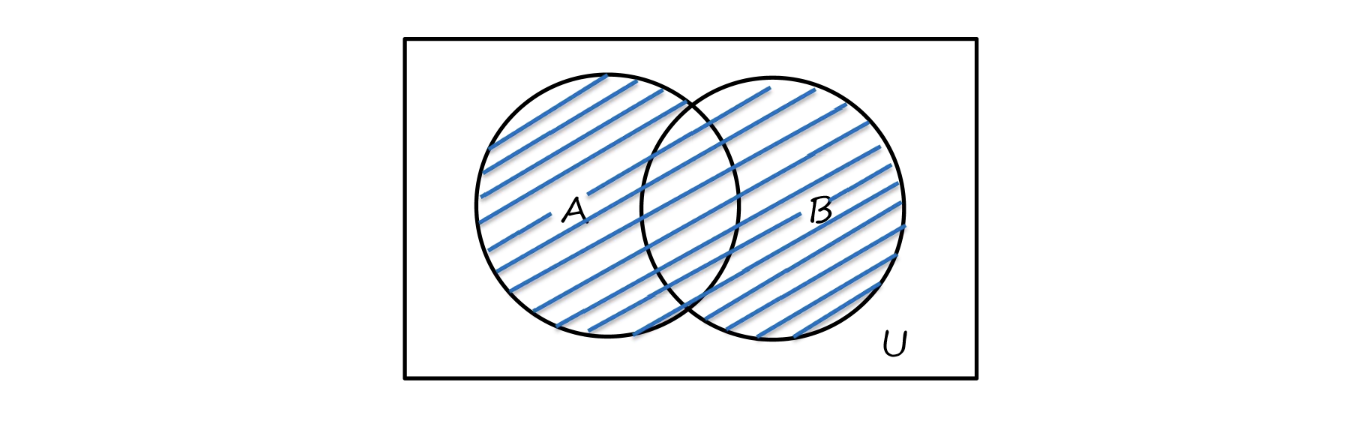
  • 并(union)
    AB={xxAxB}A \cup B = \{x|x \isin A \lor x \isin B\}

union

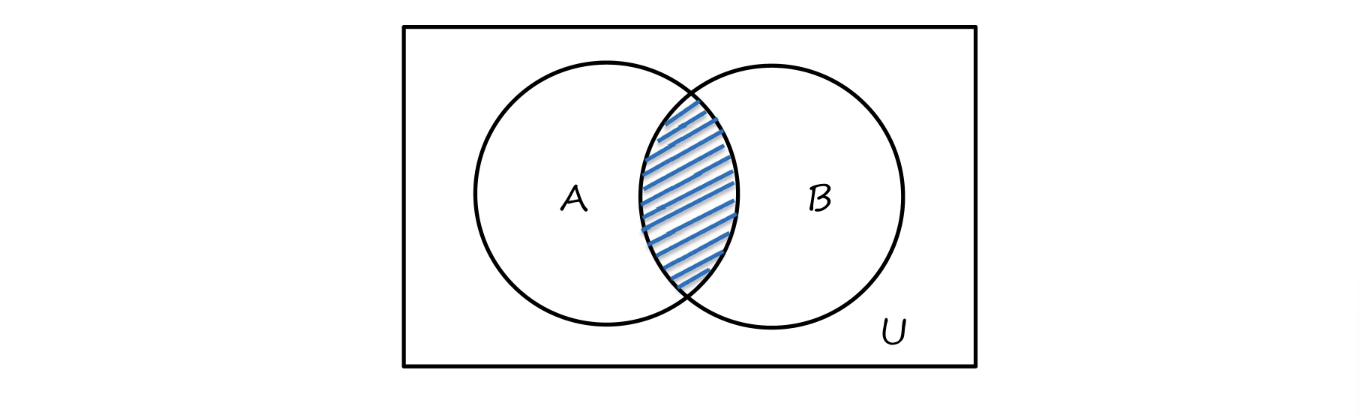
  • 交(intersection)
    AB={xxAxB}A \cap B = \{x|x \isin A \land x \isin B\}

intersection

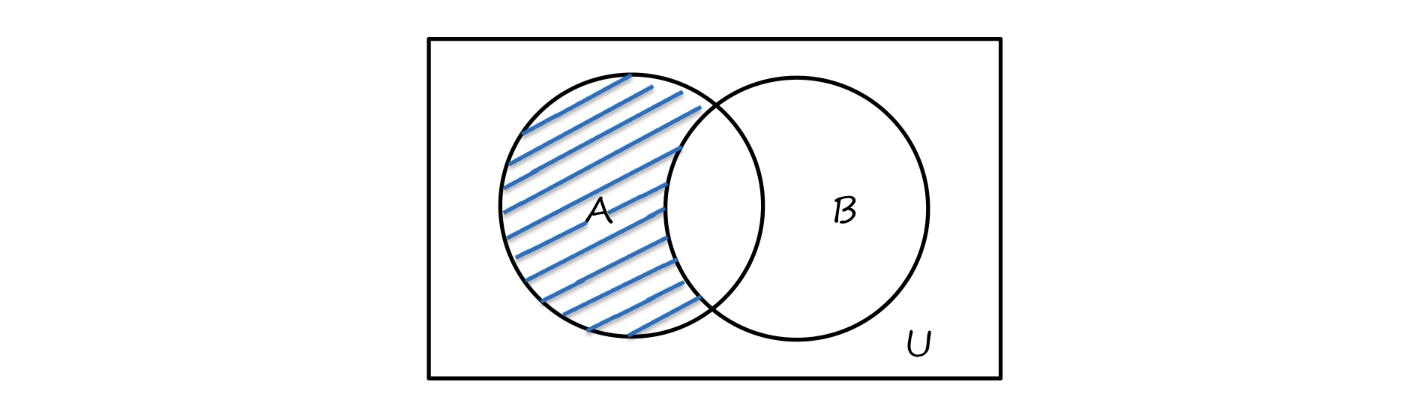
  • 差(difference)
    AB={xxAxB}A - B = \{x|x \isin A \land x \notin B\}

difference

  • 补(complement)
    A or A={xxUxA}-A~or~\overline A = \{x|x \isin U \land x \notin A\}

complement

  • 对称差(symmetric difference)
    AB={xxAxB}=(AB)(BA)A \oplus B = \{x|x \isin A \overline \lor x \isin B\} = (A - B) \cup (B - A)
    (这里的 \overline \lor 表示异或)

symmetric difference

  • 广义并(generalized union)
    A={x(z)(zAxz)}\cup A = \{x|(\exist z)(z \isin A \land x \isin z)\}
    =\cup \varnothing = \varnothing

  • 广义交(generalized intersection)
    A={x(z)(zAxz)}\cap A = \{x|(\forall z)(z \isin A \rightarrow x \isin z)\}
    \cap \varnothing 未定义。

注意广义并和广义交运算要求集合的元素也是集合。

公式

同一律(identity law)

  • AU=AA \cap U = A
  • A=AA \cup \varnothing = A

交换律(commutative law)

  • AB=BAA \cup B = B \cup A
  • AB=BAA \cap B = B \cap A

零律(domination law)

  • AU=UA \cup U = U
  • A=A \cap \varnothing = \varnothing

结合律(associative law)

  • A(BC)=(AB)CA \cup (B \cup C) = (A \cup B) \cup C
  • A(BC)=(AB)CA \cap (B \cap C) = (A \cap B) \cap C

幂等律(idempotent law)

  • AA=AA \cup A = A
  • AA=AA \cap A = A

分配律(distributive law)

  • A(BC)=(AB)(AC)A \cup (B \cap C) = (A \cup B) \cap (A \cup C)
  • A(BC)=(AB)(AC)A \cap (B \cup C) = (A \cap B) \cup (A \cap C)

双补律(complementation law)

  • (A)=A\overline {(\overline A)} = A

补余律(complement law)

  • AA=UA \cup \overline A = U
  • AA=A \cap \overline A = \varnothing

吸收率(absorption law)

  • A(AB)=AA \cup (A \cap B) = A
  • A(AB)=AA \cap (A \cup B) = A

摩根律(De Morgan's law)

  • AB=AB\overline {A \cap B} = \overline A \cup \overline B
  • AB=AB\overline {A \cup B} = \overline A \cap \overline B
  • A(BC)=(AB)(AC)A - (B \cap C) = (A - B) \cup (A - C)
  • A(BC)=(AB)(AC)A - (B \cup C) = (A - B) \cap (A - C)

相关问题证明

集合论的相关基础证明有三种解题方案:使用定义、转换为逻辑等式、使用相关定律。可以用韦恩图辅助理解,但不能将其用于证明。

下面是三个使用了不同证明方法的例子。

  1. proof AB=BABproof~A \cup B = B \Rightarrow A \subseteq B
For any x, assume xAxABAB=B xBAB\begin{aligned} &For~any~x,~assume~x \isin A \\&\therefore x \isin A \cup B \\&\because A \cup B = B~\therefore x \isin B \\&\therefore A \subseteq B \end{aligned}
  1. proof A(BC)=(AB)(AC)proof~A - (B \cup C) = (A - B) \cap (A - C)
xA(BC)(xA)(x(BC))xAxBxC(xAxB)(xAxC)(x(AB))(x(AC))x((AB)(AC))\begin{aligned} x \isin A - (B \cup C) &\Leftrightarrow (x \isin A) \land (x \notin (B \cup C)) \\&\Leftrightarrow x \isin A \land x \notin B \land x \notin C \\&\Leftrightarrow (x \isin A \land x \notin B) \land (x \isin A \land x \notin C) \\&\Leftrightarrow (x \isin (A - B)) \land (x \isin (A - C)) \\&\Leftrightarrow x \isin ((A - B) \cap (A - C)) \end{aligned}
  1. proof A(BC)=(CB)Aproof~\overline{A \cup (B \cap C)} = (\overline C \cup \overline B) \cap \overline A
A(BC)=ABC=A(BC)=(BC)A=(CB)A\begin{aligned} \overline{A \cup (B \cap C)} &= \overline A \cap \overline {B \cap C} \\&=\overline A \cap (\overline B \cup \overline C) \\&=(\overline B \cup \overline C) \cap \overline A \\&=(\overline C \cup \overline B) \cap \overline A \end{aligned}

语言识别问题

在计算问题中,判定问题可以通过decider解决,但其它问题不行。要解决其它问题,可以找出可能的答案,用decider验证答案是否正确。

某些这个过程(在某种意义上)可以转化为membership problem。定义量词 PP ,使得使 P(x)P(x) 为真的 xx 是有效输入且符合问题的要求。令 S={xP(x)}S = \{x|P(x)\} ,判断 xx 是否为有效答案时,只需要判断 xx 是否在 SS 中。

用语言识别问题(a membership problem of language)来描述,原问题可以改为“Give a language L and take w as input, determine whether wLGive~a~language~L~and~take~w~as~input,~determine~whether~w\isin L”。